
Article 13(6) · Battery information
Battery information for model 1865UC3500
This page publishes the information required by Regulation (EU) 2023/1542 for the rechargeable lithium-ion battery pack model 1865UC3500. It is the destination of the QR code marked on the battery and holds the battery label, the EU Declaration of Conformity, the due diligence policy and the waste battery information in a single permanent location.
Mandatory for all batteries placed on the EU market from 18 February 2027Document FITDO-EU-1865UC3500 Revision 1.0 · 10 Nov 2026 Manufacturer of record Dongguan KAYO Battery Co., Ltd.
- 01Identification and technical data
- 02Battery marking and label
- 03Declaration of Conformity
- 04Due diligence policy
- 05Waste battery information
- 06Transport, storage and safe use
Identification and technical data
Article 13(2) · product identification
The battery is a single-cell lithium-ion pack with an integrated USB C charging input, intended for handheld data acquisition terminals and comparable portable electronic equipment. It is classified as a portable battery within the meaning of Article 3(9). The data below reflect the current product specification and are consistent with the values marked on the label.
| General | |
| Model | 1865UC3500 (1INR19/66) |
| Battery category | Portable battery |
| Cell format and configuration | 18650 cylindrical cell, 1S1P (single cell) |
| Battery chemistry | Lithium-ion, nickel manganese cobalt oxide (NMC) |
| Nominal voltage | 3.635 V |
| Rated capacity | 3 350 mAh |
| Typical capacity | 3 450 mAh |
| Rated energy | 12.18 Wh |
| Weight | Approx. 50 g |
| Electrical characteristics | |
| Charge voltage | 4.20 V ± 0.05 V |
| Charging input | USB Type-C receptacle, 5 V DC |
| Maximum charge current | 1.5 A |
| Maximum continuous discharge current | 4 A |
| Discharge cut-off voltage | 2.5 V |
| Protection functions | Over-charge, over-discharge, over-current, short circuit, temperature (NTC) |
| Operating conditions and service life | |
| Charging temperature range | 0 °C to +45 °C |
| Discharging temperature range | −20 °C to +60 °C |
| Storage temperature range | −20 °C to +45 °C, dry conditions, 40–60 % state of charge |
| Cycle life | ≥ 500 cycles to 80 % of rated capacity |
| Manufacturer of record | |
| Legal name | Dongguan KAYO Battery Co., Ltd. |
| Postal address | No.2, Shajingtou, Ten Lane, Matigang Village, Dalingshan Town, Dongguan, Guangdong 523810, China |
| Website and e-mail | www.kayobattery.com · bu003@kayobattery.com |
| Place of manufacture | Dongguan, Guangdong, China — country of origin: China |
Manufacturer and publisher. The battery is designed, manufactured and placed on the market under the responsibility of Dongguan KAYO Battery Co., Ltd., which issues the EU Declaration of Conformity. This page is published and maintained by Shenzhen FITDO New Energy Technology Co., Ltd. as the operator of the domain on which the QR code resolves. Publishing the page does not transfer any manufacturer obligation.
Battery marking and label
Article 13(1)–(5) · Annex VI, Part A
The label below is applied to every unit. It carries the ten items of information required by Annex VI, Part A, together with the CE marking, the crossed-out wheeled bin symbol and the QR code that leads to this page. The label is indelible, legible and remains visible on the battery after it has been installed in the equipment. Where the battery is supplied already installed in equipment, the same information is made available with the equipment documentation.
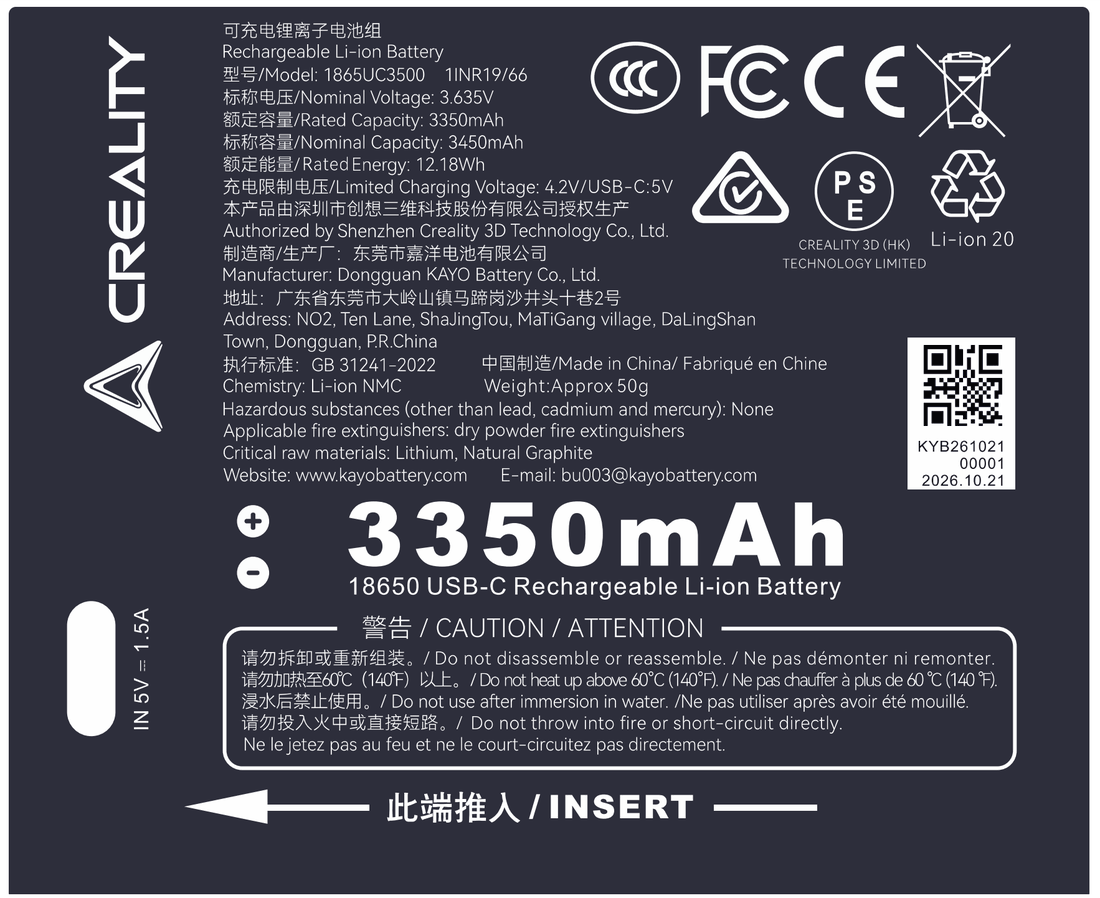
| # | Information required — Annex VI, Part A | As marked on the label |
|---|---|---|
| 1 | Manufacturer name, registered trade name or trademark, postal address, website and e-mail address | Dongguan KAYO Battery Co., Ltd. · No.2, Shajingtou, Ten Lane, Matigang Village, Dalingshan Town, Dongguan, Guangdong, China · www.kayobattery.com · bu003@kayobattery.com |
| 2 | Battery model or other identification | 1865UC3500 (1INR19/66) |
| 3 | Place and date of manufacture | Made in China; date of manufacture printed beside the traceability code in the format YYYY.MM.DD |
| 4 | Battery category | Portable battery |
| 5 | Weight of the battery | Approx. 50 g |
| 6 | Capacity of the battery | Rated 3 350 mAh; nominal 3 450 mAh; rated energy 12.18 Wh |
| 7 | Battery chemistry | Lithium-ion, NMC |
| 8 | Hazardous substances other than lead, cadmium and mercury present in the battery | None |
| 9 | Extinguishing agent that can be used to extinguish the battery | Dry powder |
| 10 | Critical raw materials present in the battery in a concentration above 0.1 % by weight | Lithium, natural graphite |
Label and code specification
| Label dimensions | 34 × 40 mm, polycarbonate film, permanent adhesive |
| QR code | 10 × 10 mm active area, 4-module quiet zone, error correction level Q (25 %) |
| QR code content | https://www.fitdoenergy.com/eu/1865UC3500/ |
| Traceability code | KYB-prefixed production code carrying batch and date of manufacture |
| CE marking | Applied in accordance with Regulation (EC) No 765/2008 |
Two codes, two purposes. The label carries a traceability code used for production, batch and warranty tracking, and the EU information QR code that opens this page. The two are independent: the traceability code does not resolve to a web address, and the QR code carries no production data.
Units already in stock. Batteries that were labelled and placed on the market before 18 February 2027 keep their existing label. The QR code on those units resolves to this same address, so no relabelling is required if the content of this page is updated.
EU Declaration of Conformity
Article 18 · Annex VIII · retention under Article 38
The EU Declaration of Conformity is issued by the manufacturer of record, Dongguan KAYO Battery Co., Ltd. It identifies the battery, states the legislation and the harmonised standards applied, and is signed on behalf of the manufacturer. It is provided in the languages of the Member States in which the battery is placed on the market; the English text prevails in the event of any discrepancy.
PDF EU Declaration of Conformity — model 1865UC3500 Ten languages: EN · DE · FR · ES · IT · NL · PL · CS · SV · DA | 11 pages | Revision 1.0 Download PDF→Legislation and standards declared
| Regulation | Regulation (EU) 2023/1542 on batteries and waste batteries |
| Electromagnetic compatibility | Directive 2014/30/EU |
| Restriction of hazardous substances | Directive 2011/65/EU as amended by (EU) 2015/863 |
| Battery safety | EN IEC 62133-2:2017 + A1:2021 |
| Emission and immunity | EN 55032:2015 + A1:2020 (Class B) · EN 55035:2017 + A11:2020 |
| Technical documentation | EN IEC 63000:2018 |
| Transport testing | UN 38.3, Manual of Tests and Criteria, section 38.3 |
| Substances of very high concern | Regulation (EC) No 1907/2006 (REACH) — no SVHC above 0.1 % by weight |
Availability of supporting documents
The technical documentation, the UN 38.3 test summary and the test reports listed above are retained by the manufacturer and kept available to market surveillance authorities for ten years after the last unit has been placed on the market, in accordance with Article 38. Distributors and customers may request copies for their own conformity assessment through the contact address in the footer of this page.
Battery due diligence policy
Chapter VII · Articles 48–52
Article 48 requires economic operators that place batteries on the market and have a net turnover above EUR 40 million to establish, implement and publish a battery due diligence policy. The policy covers the sourcing of cobalt, natural graphite, lithium and nickel and follows the five-step framework of the OECD Due Diligence Guidance for Responsible Business Conduct. The policy published here applies to this battery irrespective of any lighter regime available to small and medium-sized enterprises.
Scope of the policy
- Management commitment. A written commitment, adopted at management level, to responsible sourcing and to the identification and mitigation of supply chain risks.
- Risk identification and assessment. Mapping of the supply chain down to smelter and refiner level, with assessment of social and environmental risks in conflict-affected and high-risk areas.
- Risk management response. Measures to prevent, mitigate or disengage from identified risks, with defined responsibilities, timelines and escalation paths.
- Third-party verification. Verification of the policy and of its implementation by a notified body, in accordance with Article 50.
- Public reporting. Publication of the policy and of an annual report on its implementation, including the smelter and refiner list.
Materials in scope
| Cobalt | Present in the cathode active material |
| Natural graphite | Present in the anode active material |
| Lithium | Present in the cathode active material and in the electrolyte |
| Nickel | Present in the cathode active material |
| Reporting threshold | Materials present above 0.1 % of the battery weight are reported individually |
Supply chain transparency. Smelter and refiner information for the four critical raw materials contained in this battery is available to customers, distributors and market surveillance authorities on request, so that they can meet their own due diligence obligations under Article 48 without duplicating the upstream assessment.
Waste battery prevention and management
Article 74 · extended producer responsibility, Articles 56–60
Lithium-ion batteries must never be disposed of with unsorted municipal waste. The crossed-out wheeled bin symbol on the label indicates that the battery is subject to separate collection, and take-back is free of charge for the end user. The battery does not contain mercury, cadmium or lead.
What to do with a battery at the end of its life
| Collection | Return the battery free of charge to a municipal collection point, a retail take-back point, or an authorised battery recycler in your country. Do not place it in household waste and do not incinerate it. |
| Preparation | Discharge the battery, insulate the terminals with adhesive tape, and keep the battery away from metal objects during storage and transport. |
| Safety | Do not open, crush, puncture, immerse or expose the battery to temperatures above 60 °C. A damaged or swollen cell may ignite. |
| Fire risk | Store a damaged battery away from combustible material and hand it over to a collection point without delay. Dry powder is the suitable extinguishing agent. |
| Prevention | Extend service life by avoiding deep discharge, keeping the battery between 15 °C and 25 °C where possible, and using only the specified USB C charger. |
| Recycling | Cobalt, nickel, copper and lithium are recovered from collected cells. Recycling recovers critical raw materials and prevents soil and water contamination. |
Collection and recycling targets under the Regulation
| Obligation | By 31 Dec 2027 | Later target |
|---|---|---|
| Collection rate, portable batteries | 63 % | 73 % by 31 Dec 2030 |
| Recycling efficiency, lithium-based batteries | 50 % | 80 % by 31 Dec 2031 |
| Material recovery, cobalt, copper, lead and nickel | 90 % | 95 % by 31 Dec 2031 |
| Material recovery, lithium | 50 % | 80 % by 31 Dec 2031 |
Take-back in your country. Nationwide collection is organised through the producer responsibility organisation registered for the Member State in which the battery is placed on the market. Contact the address in the footer of this page to obtain the collection network operating in your country, or return the battery to any municipal collection point.
Transport, storage and safe use
UN 38.3 · dangerous goods classification
The battery has been tested in accordance with the UN Manual of Tests and Criteria and is classified for transport as a lithium-ion battery contained in or packed with equipment.
| UN number | UN 3481 |
| Transport class | Class 9, miscellaneous dangerous goods |
| Packing instruction | IATA Dangerous Goods Regulations PI 967; IMDG Code, as applicable |
| Test summary | UN 38.3 test summary available from the manufacturer on request |
| Storage | Dry, well ventilated area, away from direct sunlight, heat sources and metal objects; 40–60 % state of charge for long-term storage |
Safety instructions
- Charge only through the integrated USB C input with a charger that complies with SELV and LPS requirements, at a maximum of 1.5 A.
- Do not short-circuit the terminals, do not connect the battery in reverse polarity and do not solder directly to the cell.
- Do not expose the battery to temperatures above 60 °C, do not leave it in a vehicle in direct sunlight and do not incinerate it.
- Do not open, deform, drop or apply mechanical force to the battery. Stop using it if the housing is damaged, if it emits an odour or if it becomes noticeably hot during charging.
- Keep the battery out of the reach of children. In case of contact with a leaking cell, rinse with water and seek medical advice.
- A battery that has been damaged or immersed in water must be isolated, placed in a non-combustible container and handed over to a collection point.
End-of-life handling. Never store a fully discharged battery for an extended period; recharge it to approximately 50 % before storage to prevent over-discharge damage, and transfer it to separate collection as soon as it reaches the end of its service life.
Regulatory reference and document control
Article 13(6) checklist · key dates · revision history
Information required by Article 13(6)
| Requirement | Where it is published |
|---|---|
| Battery marking and label | Annex VI, Part A — Section 02 of this page |
| EU Declaration of Conformity | Article 18 and Annex VIII — Section 03, downloadable PDF |
| Battery due diligence policy | Articles 48–52 — Section 04, downloadable PDF |
| Waste battery prevention and management | Article 74 — Section 05, downloadable PDF |
| Supporting technical information | Sections 01 and 06 — identification, transport, storage and safe use |
Key dates under Regulation (EU) 2023/1542
| Date | Obligation |
|---|---|
| 18 Aug 2024 | Regulation applies; labelling according to Annex VI, Part A |
| 18 Aug 2025 | Due diligence obligations apply to operators above the turnover threshold |
| 18 Feb 2027 | QR code on the battery becomes mandatory (Article 13(6)) |
| 31 Dec 2027 | Portable battery collection target of 63 %; first material recovery targets |
| 31 Dec 2030 | Portable battery collection target of 73 % |
| 31 Dec 2031 | Increased recycling efficiency and material recovery targets |
Portable batteries are not subject to the battery passport under Article 77, which applies to light means of transport batteries, industrial batteries above 2 kWh and electric vehicle batteries. The QR code on this battery therefore carries the information required by Article 13(6) only.
Document control
| Document reference | FITDO-EU-1865UC3500 |
| Revision | 1.0 |
| Effective date | 10 November 2026 |
| Next scheduled review | 18 February 2027, then annually |
| Publisher of this page | Shenzhen FITDO New Energy Technology Co., Ltd. |
| Manufacturer of record | Dongguan KAYO Battery Co., Ltd. |
| Language | English. Declarations in other official languages of the Union are contained in the Declaration of Conformity. |
| Retention | Documents are retained and kept available for ten years after the last unit has been placed on the market |
Revision history
| Rev. | Date | Description |
|---|---|---|
| 1.0 | 10 Nov 2026 | First issue. Battery label, Declaration of Conformity, due diligence and waste battery information published. |